The Challenge
Manual Chart Review Bottleneck
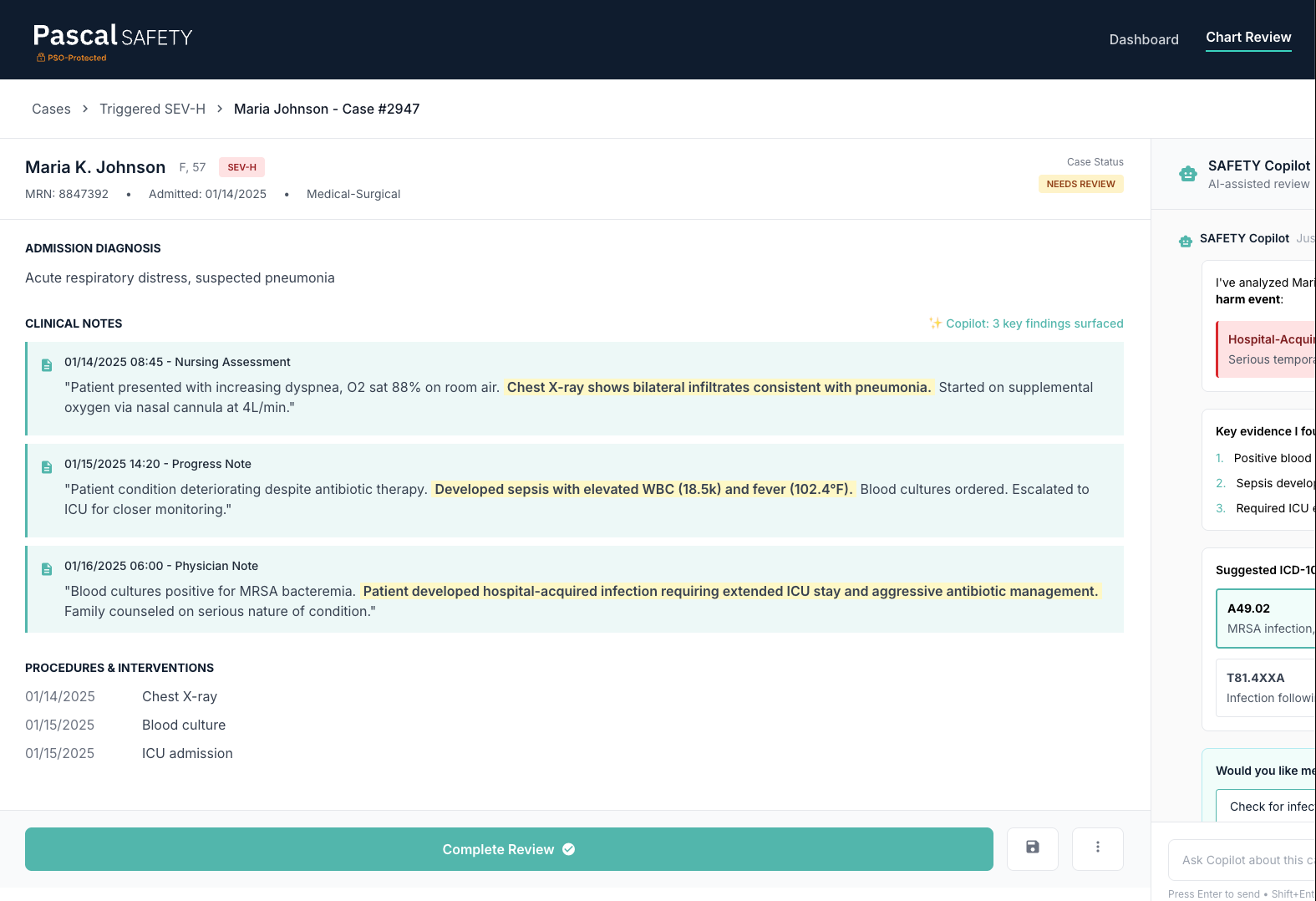
Pascal Metrics' internal Expert Clinical Review (ECR) nurses were overwhelmed by the time-intensive process of manually reviewing triggered charts. Each verification took nearly 30 minutes, with inconsistent documentation quality across reviewers.
Core Problems:
- Manual Signal Hunting: Nurses spent excessive time searching through lengthy charts for relevant evidence
- Inconsistent Documentation: Variable narrative tone and format across different reviewers
- Requests for Revision: Frequent requests from client hospitals to change severity, preventability, and other key fields
Legacy Review Process
Trigger Notification
System flags potential adverse event
~2 minManual Chart Review
Nurse manually searches through entire chart
~18 minDocumentation
Manual entry with multiple revisions
~8 min"There's so many places you have to go to look for what happened, or what didn't happen. It's a lot of clicking and scrolling and back and forth. It just takes time." — ECR Nurse
Research & Insights
🔍 Key Research Insight
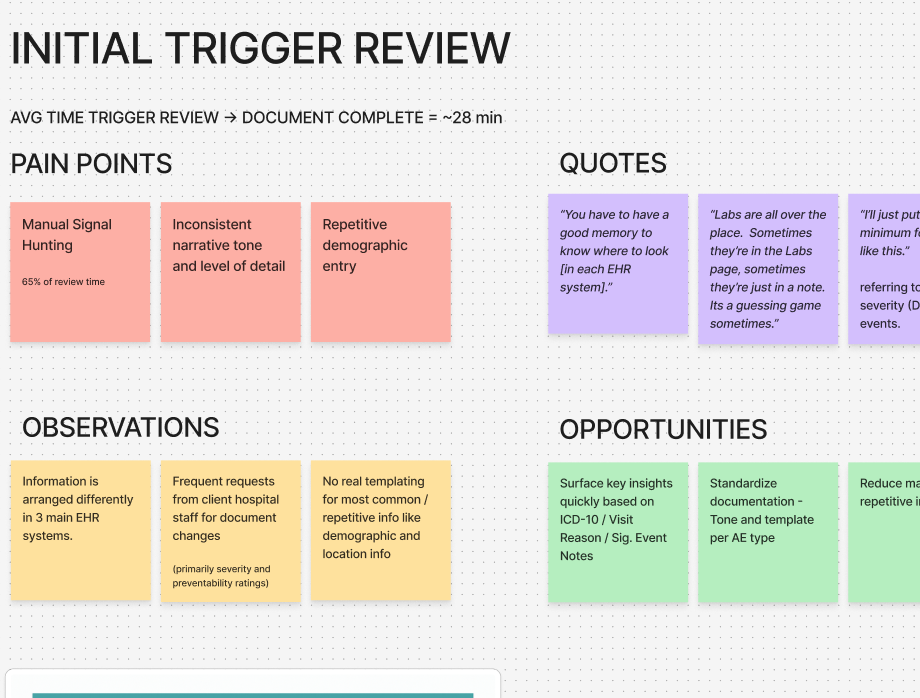
65% of review time was spent hunting for evidence scattered across progress notes, labs, and medication orders. Nurses knew what they were looking for but had to manually search through hundreds of entries to find the "smoking gun" that confirmed or ruled out harm.
- Contextual Inquiry: Shadowed 10 ECR nurses across two facilities to understand their workflow, pain points, and decision-making process. 28 min average per chart, 3.2 doc revisions
- Data Audit: Analyzed 2,450 historical verified events across 11 common trigger types to identify patterns and optimization opportunities. 11 trigger types: med reversal, HAIs, falls
- Pain Point Analysis: Identified key friction points including manual signal hunting, inconsistent narrative tone, and repetitive demographic entry. Manual hunting = 65% of review time
- Jobs-to-be-Done: Defined core job: "When a trigger fires, help me confirm harm quickly and record it consistently." Focus on speed + consistency
Design Process
💡 Design Challenge
How do we help nurses find critical evidence 10× faster without changing their clinical judgment process? Our approach: AI surfaces relevant signals automatically, highlights suspect entries in context, and suggests documentation—but nurses retain full control over verification and decision-making.
Understanding Clinical Review Patterns
Mapped how experienced nurses identify harm signals across different chart types. Collaborated with clinical SMEs to define what evidence matters most for each trigger category (falls, medication errors, HAIs), then designed AI-assisted extraction to surface those specific signals automatically.
- Clinical workflow analysis for 11 trigger types
- Evidence hierarchy mapping with nurse SMEs
- Automated signal extraction design (vitals, orders, notes)
- Validation testing with expert reviewers
Wireframe Sprint
Created split-screen layout with evidence timeline and copilot chat panel for optimal workflow integration.
- Mid-fi prototype with split-screen design
- Workflow integration testing
- Rapid iteration with nurse feedback
Copilot Behavior Definition
Designed clarifying questions, best-practice tone suggestions, and ICD-10 auto-suggest functionality.
- Conversation script library
- Tone suggestion system
- ICD-10 auto-suggest
Solution
ECR Copilot transforms chart review by automatically extracting relevant evidence, providing smart suggestions, and offering documentation assistance—enabling nurses to focus on clinical judgment rather than information hunting.
Evidence Timeline
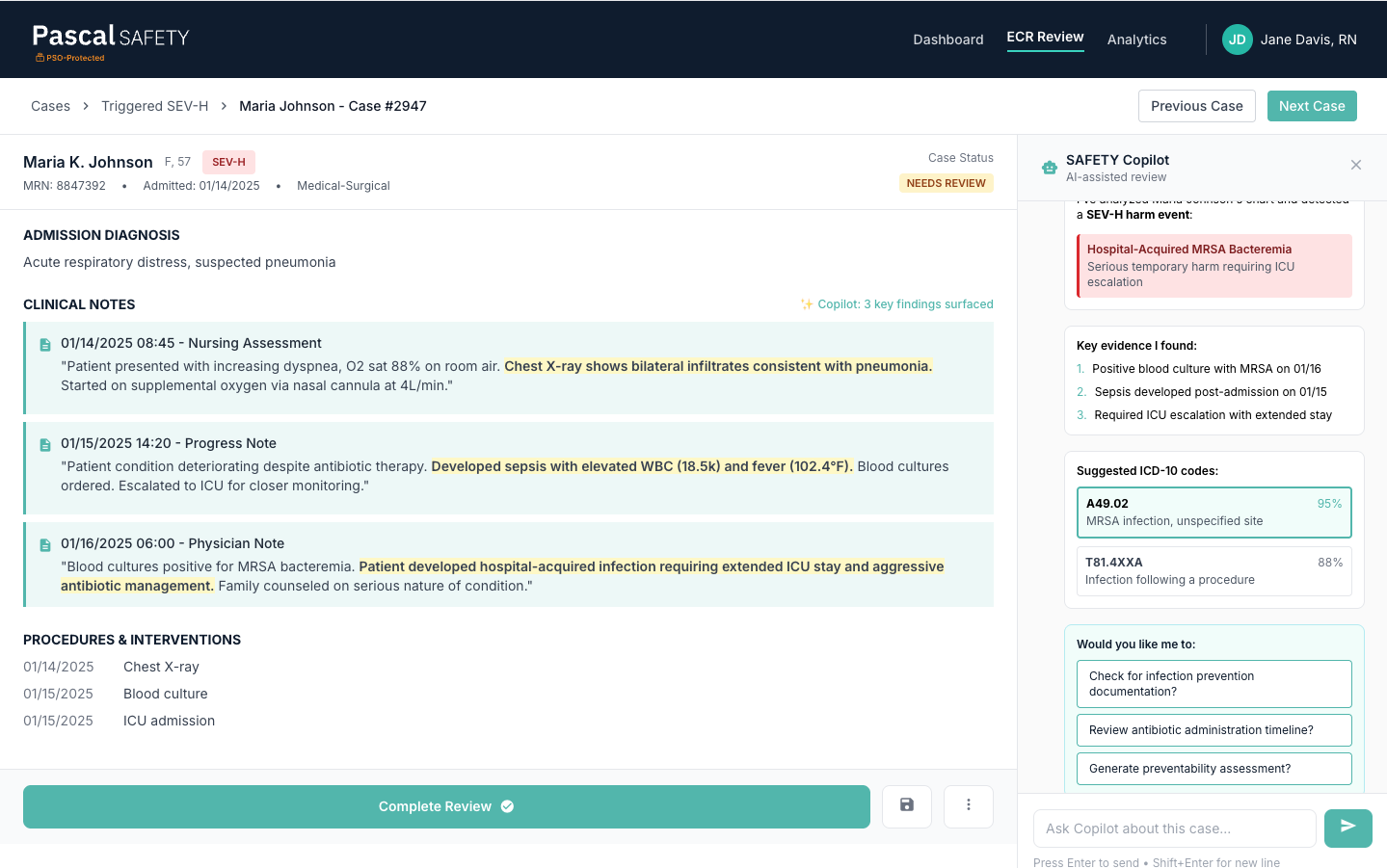
Chronological notes, labs, and medications with AI-highlighted suspect entries. Nurses can click any highlighted item to see why the AI flagged it and jump directly to source documentation.
Copilot Chat Panel
Conversational interface suggests relevant follow-up questions ("Was there a physician order for this medication?"), auto-fills demographics, and offers clarifying prompts based on chart context.
Smart Templates
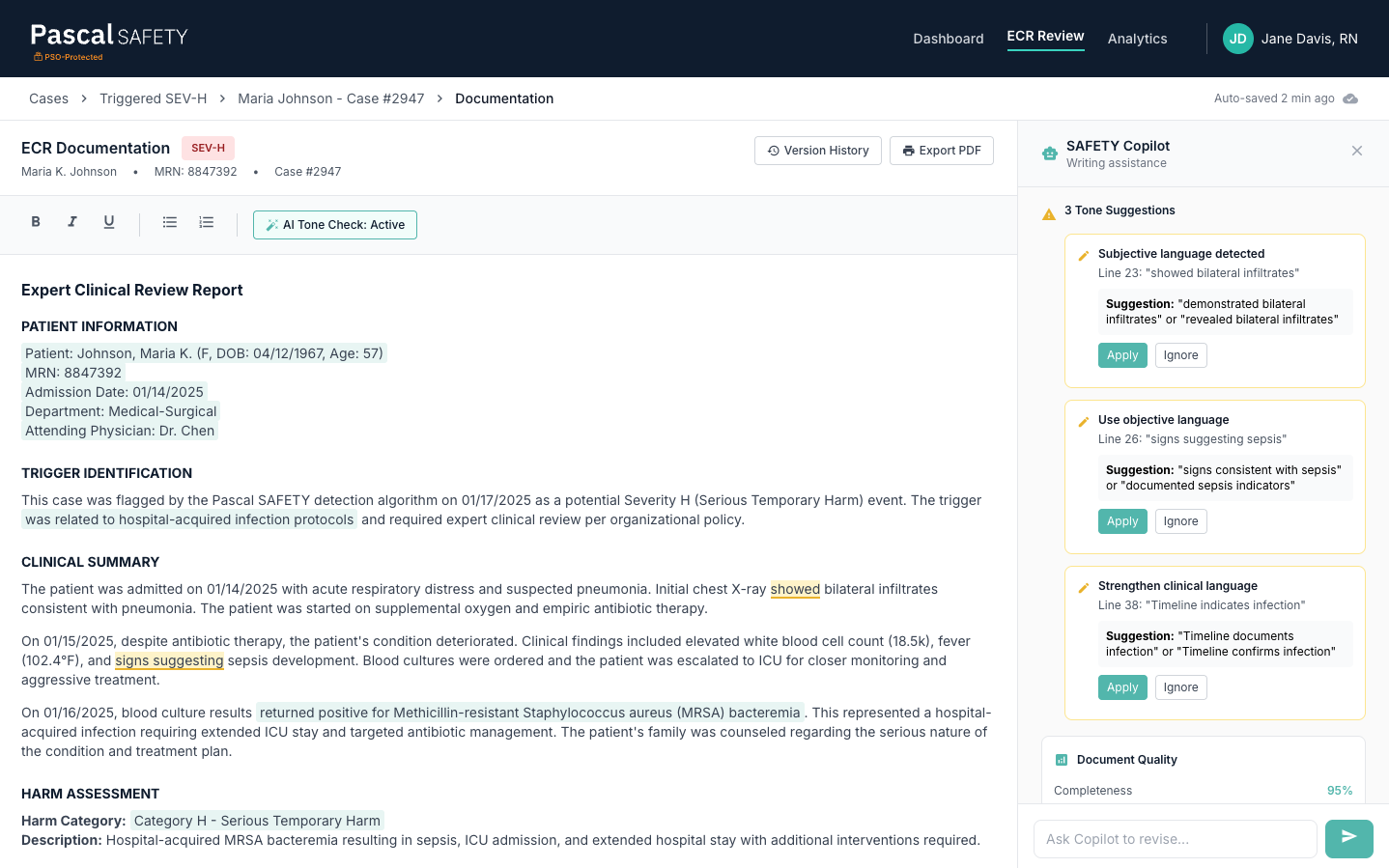
Dynamic narrative templates with auto-populated patient information, trigger details, and evidence summaries. Nurses edit for accuracy rather than typing from scratch.
Tone Check & Suggestions
AI flags subjective language in real-time ("appears to be" → "is documented as") and offers concise alternatives that meet documentation standards.
Impact
56%
Faster Verification
27 min → 11 min avg
2x
Charts per Shift
11.4 → 22.8 charts
85%
Inter-rater Reliability
↑33% improvement
1.2
Editing Passes
Down from 3.2
"Copilot finds the smoking-gun line in seconds—I just verify and move on. This is so cool." — Senior ECR Nurse