The Challenge
Reactive Risk Management
Before Pascal RISK, risk management teams were trapped in a reactive cycle. Critical adverse events often went undetected for weeks, with investigations starting long after patients had left the hospital. This delay increased legal exposure and made proactive mitigation nearly impossible.
- Delayed Response: Most events discovered after discharge, missing the window for intervention
- Resource Intensive: Manual review of thousands of reports, most of which were irrelevant
- Missed Opportunities: Many preventable events weren't caught until after harm occurred
Legacy Process Timeline
Event Occurs
Adverse event happens
Day 1Med-Mal Claim Received
Notification of lawsuits avg. 32 days post-discharge
Day 32Risk Review
Risk manager reviews claim and assigns to legal team
Day 33Investigation and Litigation
Opportunity to mitigate harm or legal exposure lost
Day 34+"We were always fighting fires instead of preventing them. By the time we knew about an issue, the patient was already home." — Risk Management Executive, Client Hospital
Research & Insights
Stakeholder Alignment Challenge
Balancing competing needs across three key stakeholders: Risk managers wanted early detection with high sensitivity, patient safety nurses needed actionable insights without alert fatigue, and malpractice attorneys required defensible documentation. Solution: Configurable sensitivity thresholds with role-based dashboards.
- Stakeholder Research: 9 risk manager interviews, 6 patient safety nurse sessions, 2 malpractice attorney consultations, process mapping workshops
- Data Analysis: Thousands of historical events reviewed, 120 candidate triggers identified, 7 critical hand-off points mapped, 3 system integration points
- Signal Design: Data science workshops, clinical validation sessions, trigger prioritization matrix, false positive reduction strategy
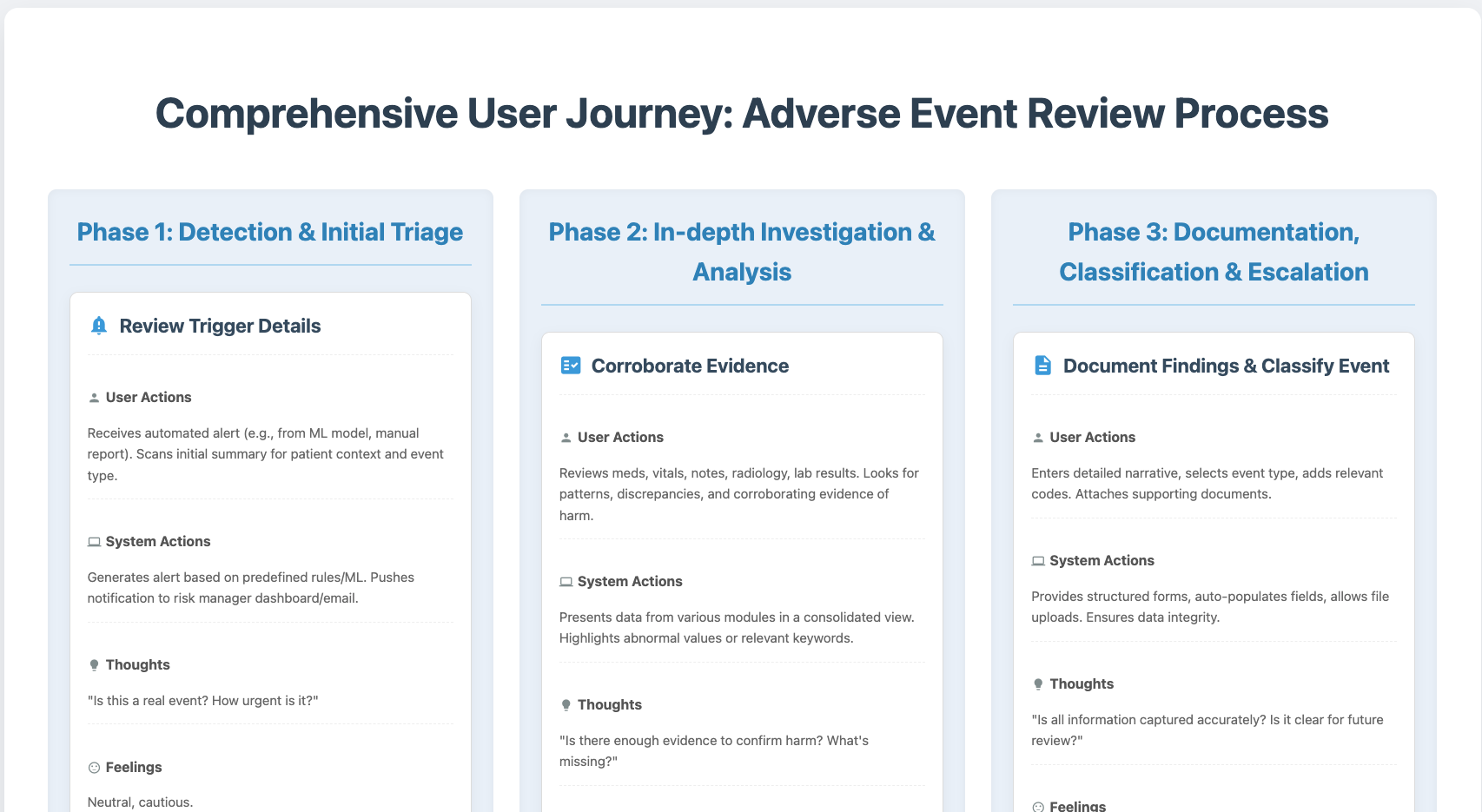
- User Experience: Journey mapping exercises, interactive prototyping, usability testing sessions
Design Process
Design Challenge
How do we detect adverse events in real-time without overwhelming risk teams with false alarms? Our approach: Machine learning reduces false positives by 81% while maintaining 93% event capture—prioritizing critical cases for immediate action while filtering out noise.
Signal Identification
Collaborated with clinical informaticists to identify the most predictive indicators of adverse events across EMR systems.
- 120 candidate triggers
- Clinical workshops
- 82 validated signals
Algorithm Development
Worked with data science team to build machine learning models that reduce false positives while maintaining high sensitivity.
- Model training & validation
- False positive reduction
- Continuous improvement loop
Interface Design & UX Decisions
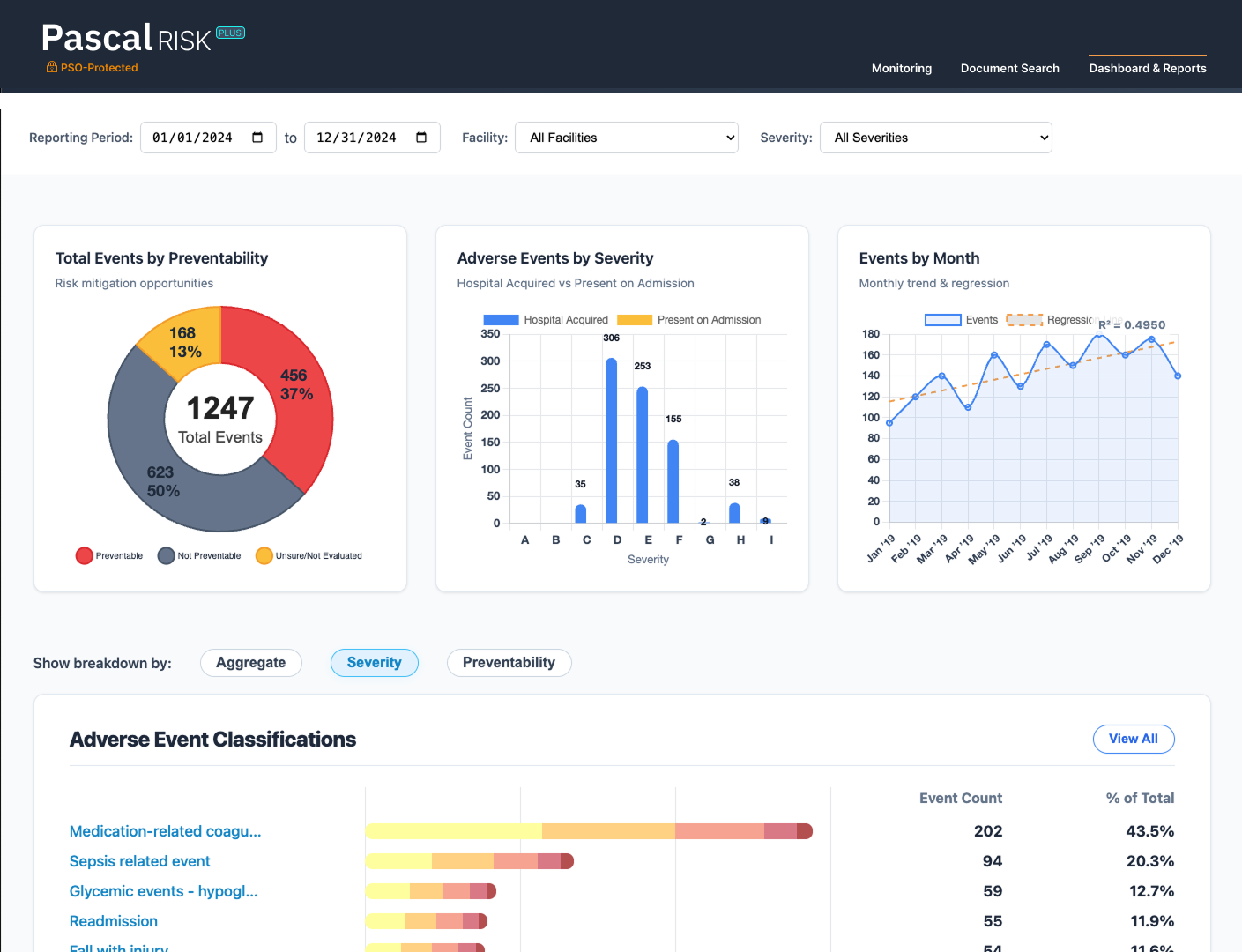
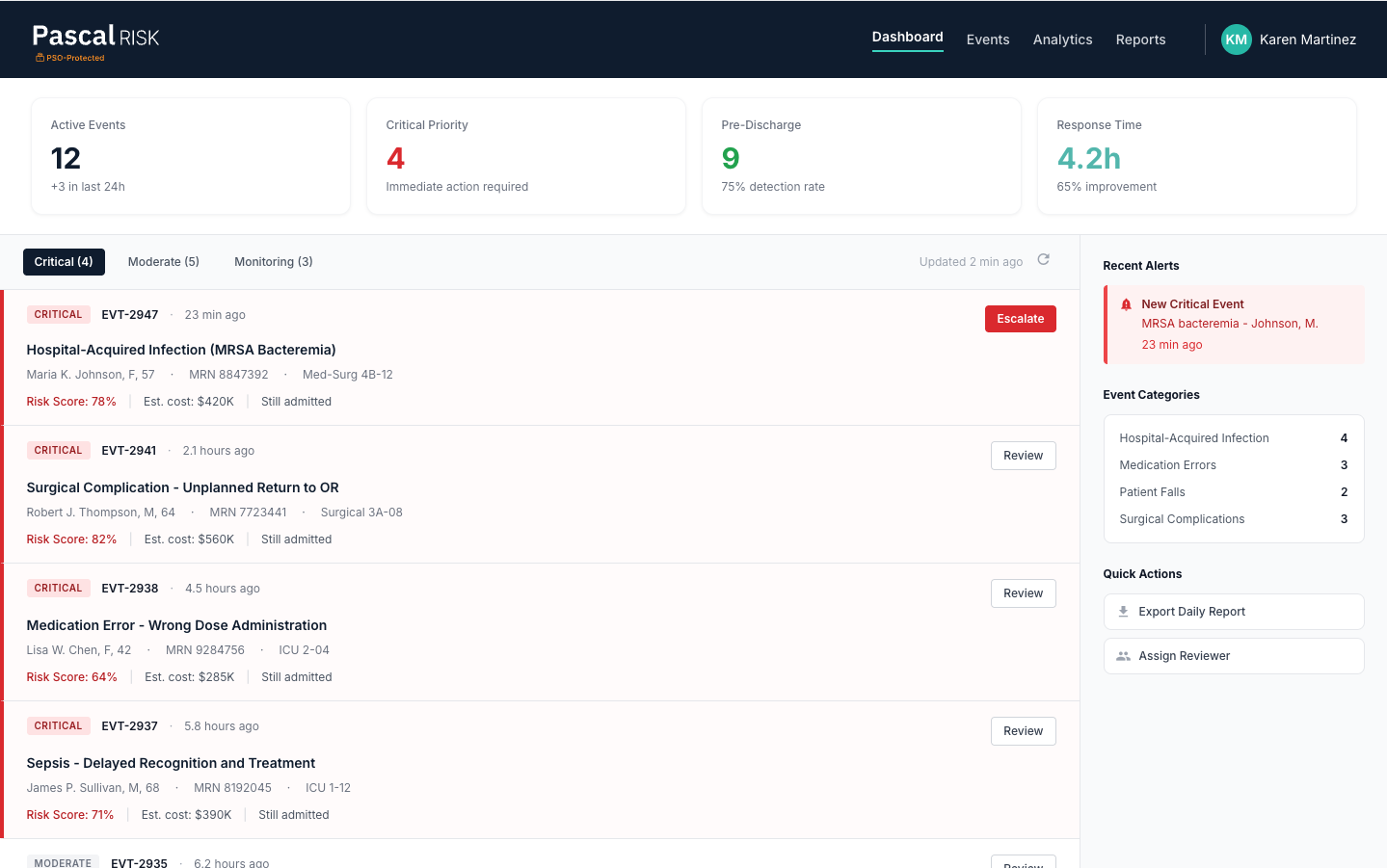
Designed notification hierarchy and dashboards that surface critical events immediately while preventing alert fatigue. Key UX decision: Color-coded severity system (red=critical, yellow=moderate, gray=monitoring) with configurable thresholds per facility.
- Mobile-first responsive design for on-call risk managers
- Severity-based color coding with one-tap escalation
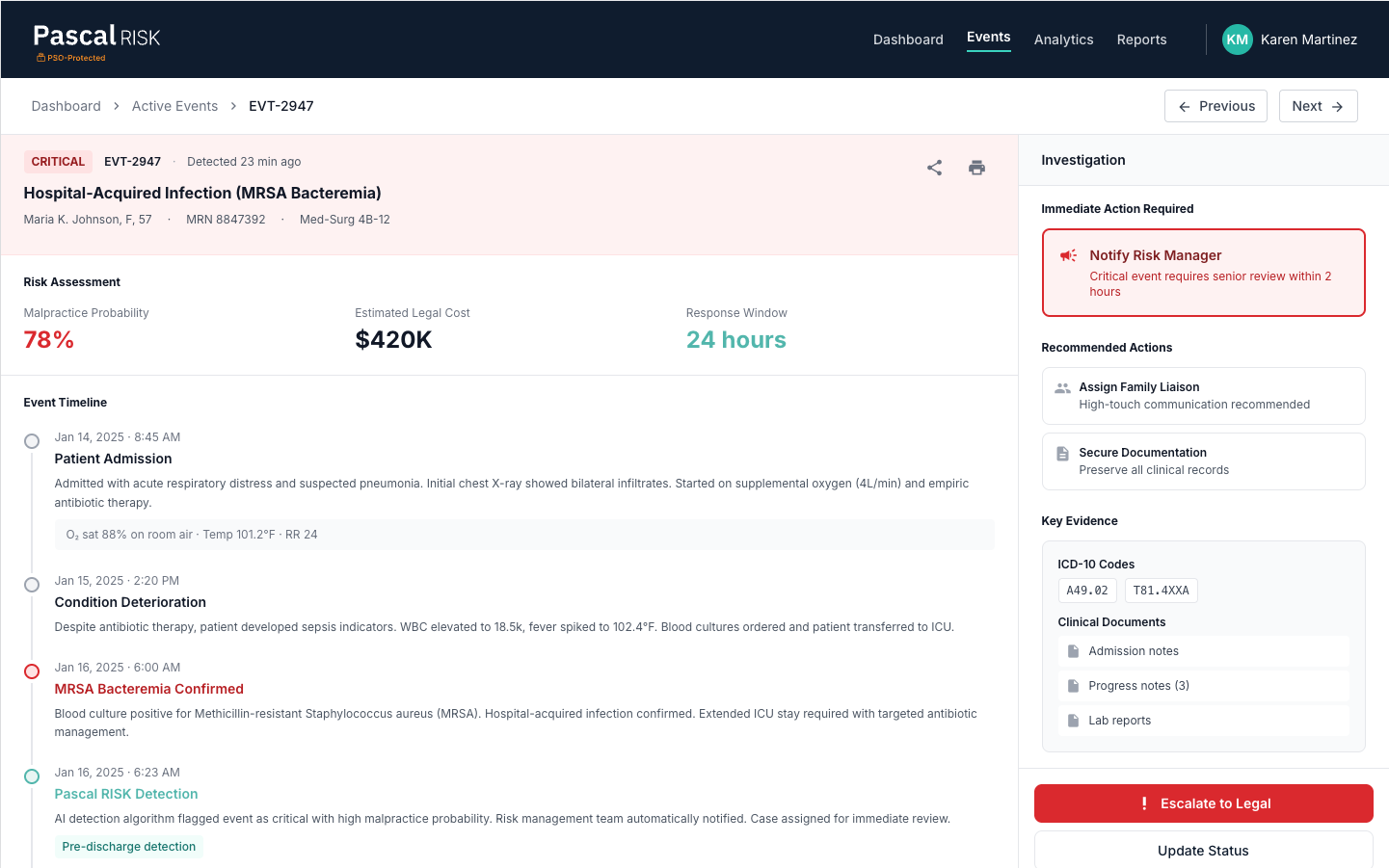
- Interactive timeline showing event progression and interventions
- Role-based views: Risk managers see legal exposure, nurses see clinical context
Pilot & Validation
Conducted phased rollout with continuous monitoring and optimization based on real-world usage patterns.
- Phased rollout
- Continuous monitoring
- Detection time improvement
Solution
Pascal RISK enabled risk management to intervene often, while the patient was still in the hospital, not weeks later. Automated validation and notification reduced manual workload and focused attention on the most critical events. Proactive mitigation steps now routinely prevent lawsuits and reduce financial exposure.
Real-Time Monitoring Engine
- • 82 structured data signals
- • Machine learning validation pipeline
- • Epic EMR system integration
User Interface
- • Severity-based prioritization
- • Interactive timeline visualization
- • Web dashboard for risk managers
Workflow Automation
- • Automated event validation
- • Escalation routing
- • Documentation generation
- • Compliance reporting
Impact
9 days
Median Investigation Time
↓90% (from 91 days)
41%
Relevant Risk Events
↑10x improvement
Proactive
Mitigation
Most cases addressed before discharge
174
Interviews in 2024
Key context captured for legal defense
"For the first time, we're preventing lawsuits, not just defending them. Pascal Risk gives us a chance to intervene before harm escalates—and before legal costs spiral." — Director, Risk Services
Lloyd's Lab Cohort 12 - Most Innovative Product
Recognized for breakthrough innovation in medical malpractice risk management at the world's leading insurance innovation accelerator
Presented to global insurance leaders at Lloyd's of London, demonstrating how real-time patient harm detection reduces risk exposure and medical malpractice costs for insurers and health systems.